
Walmart deductions are the largest single source of preventable margin loss for most Walmart suppliers. Every shortage, pricing gap, compliance failure, and SQEP defect gets deducted from your payment automatically, and the dispute rules leave zero room for error. Miss the window, submit the wrong backup, or file at the PO level when the fine is at the item level, and the deduction becomes a permanent write-off.
The dispute process itself has changed materially over the last three years. Settlement Disputing is gone. APDP replaced it in May 2023 for standard deductions. EIPP now handles SQEP fines under a separate ruleset. Each portal has its own submission rules, dispute windows, and evidence requirements, and knowing which portal to use for which fine is the first step to actually recovering revenue.
Why Walmart Deductions Are the Biggest Margin Threat for Suppliers
Walmart's automated compliance systems now generate deductions in real time at the line-item level, and the financial exposure adds up quickly.
- SQEP program: $200 administrative fee per non-compliant PO plus $1 per non-compliant case
- OTIF program: 3 percent of the cost of goods on non-compliant cases
- Post-audit claims: surface weeks or months after the original transaction, when documentation is hardest to reconstruct
A supplier shipping $20 million annually through Walmart with a 5 percent compliance miss rate is exposed to roughly $30,000 in OTIF penalties alone, before adding SQEP fines, ASN chargebacks, and standard shortage or pricing deductions. For high-volume suppliers, total Walmart deductions frequently reach 3 to 8 percent of gross revenue.
Walmart's Two Dispute Portals: APDP vs EIPP Explained
The single most important thing to understand about Walmart deduction recovery in 2026 is that there are two dispute portals, each covering different fine types.
| Portal | What It Handles | Access Path |
|---|---|---|
| APDP (Accounts Payable Disputes Portal) | Standard invoice deductions (shortages, pricing, compliance-related codes) | Retail Link > APDP |
| EIPP (Enterprise Invoice Presentment and Payment) | SQEP fines (packaging, labeling, ASN accuracy, receiving defects) | EIPP portal (integrated with Retail Link) |
Standard deductions like Code 22 (Goods Billed Not Shipped) go through APDP. SQEP fines like PO Accuracy, ASN, or Pallet/Load defects go through EIPP. Filing the wrong dispute in the wrong portal is one of the most common denial triggers.
How APDP Replaced Settlement Disputing in 2023
Walmart phased out Settlement Disputing in May 2023 and replaced it with APDP. The shift was structural, not cosmetic.
What Settlement Disputing Looked Like
Settlement Disputing batched deductions across shipments and settled them quarterly. It was convenient for large suppliers but produced long cash flow lags and offered limited visibility into individual claim outcomes.
What APDP Requires Today
APDP requires each dispute to be filed at the claim line level. If Walmart deducted for Code 22 on three items in one invoice, but only one item was actually missing, you now dispute only that specific line rather than the full invoice.
The tradeoff is scale. APDP delivers more precision but requires more disputes. For high-volume suppliers, that shift is the main reason manual dispute processes broke, and automation became necessary.
Key Advantages of the APDP System
- Line-level disputes: file exactly what needs to be disputed, no more, no less
- Direct access through Retail Link: no separate login or account creation
- Direct communication with dispute analysts: faster resolution and clearer status tracking
- Real-time dispute status: know where every claim sits without emailing for updates
How to Dispute Walmart Deductions in APDP: Step-by-Step
The APDP workflow follows a consistent structure. Each step has a failure mode that can send the dispute to automatic denial.
- Log in to Retail Link and open the APDP application
- Identify the deduction using the claim number from the remittance
- Verify the code and confirm APDP is the correct portal (not EIPP)
- Gather the required documentation based on the deduction type
- Submit the dispute at the line level with the exact dispute amount
- Attach all backup documents in the required format
- Track the dispute status and respond to any follow-up requests
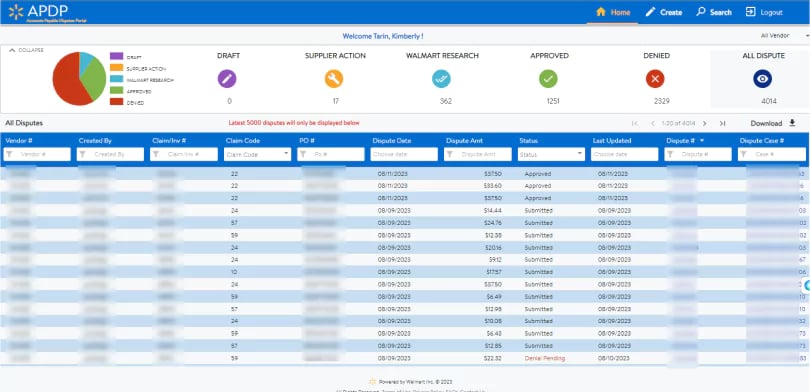
Every dispute must reconcile exactly with the backup documentation. For any adjustment where dollar precision matters (especially SQEP-adjacent codes), the tolerance is zero.
Common Walmart Deduction Codes and What They Mean
Understanding the codes is the foundation of successful recovery. Walmart uses a structured code system across shortages, pricing, and compliance.
Walmart Shortage Deduction Codes
| Code | Description |
|---|---|
| Code 21 | Concealed Shortages |
| Code 22 | Goods Billed Not Shipped |
| Code 23 | Carton Shortages |
| Code 24 | Carton Shortage (line-level) |
| Code 25 | No Merchandise Received |
Walmart Pricing and Allowance Deduction Codes
| Code | Description |
|---|---|
| Code 10 | Allowance Difference / Price Difference as Documented |
| Code 11 | Pricing Overcharge (Price Difference between PO and Invoice) |
| Code 13 | Substitution at Higher Cost |
| Code 31 | PO Number Not on Invoice |
Walmart Compliance and OTIF Deduction Codes
| Code | Description |
|---|---|
| Code 64 | Early Shipment (OTIF) |
| Code 65 | Late Shipment (OTIF) |
| SQEP fines | PO Accuracy, ASN, Pallet/Load, Barcode/Labeling, DC-Unfound PO |
Code 10 in particular is worth attention. It fires from any of three trigger types (allowance mismatch, pack quantity error, or pricing error) and applies across DC invoices, direct-to-store invoices, and Sam's Club invoices.
Documentation Required to Dispute Walmart Deductions
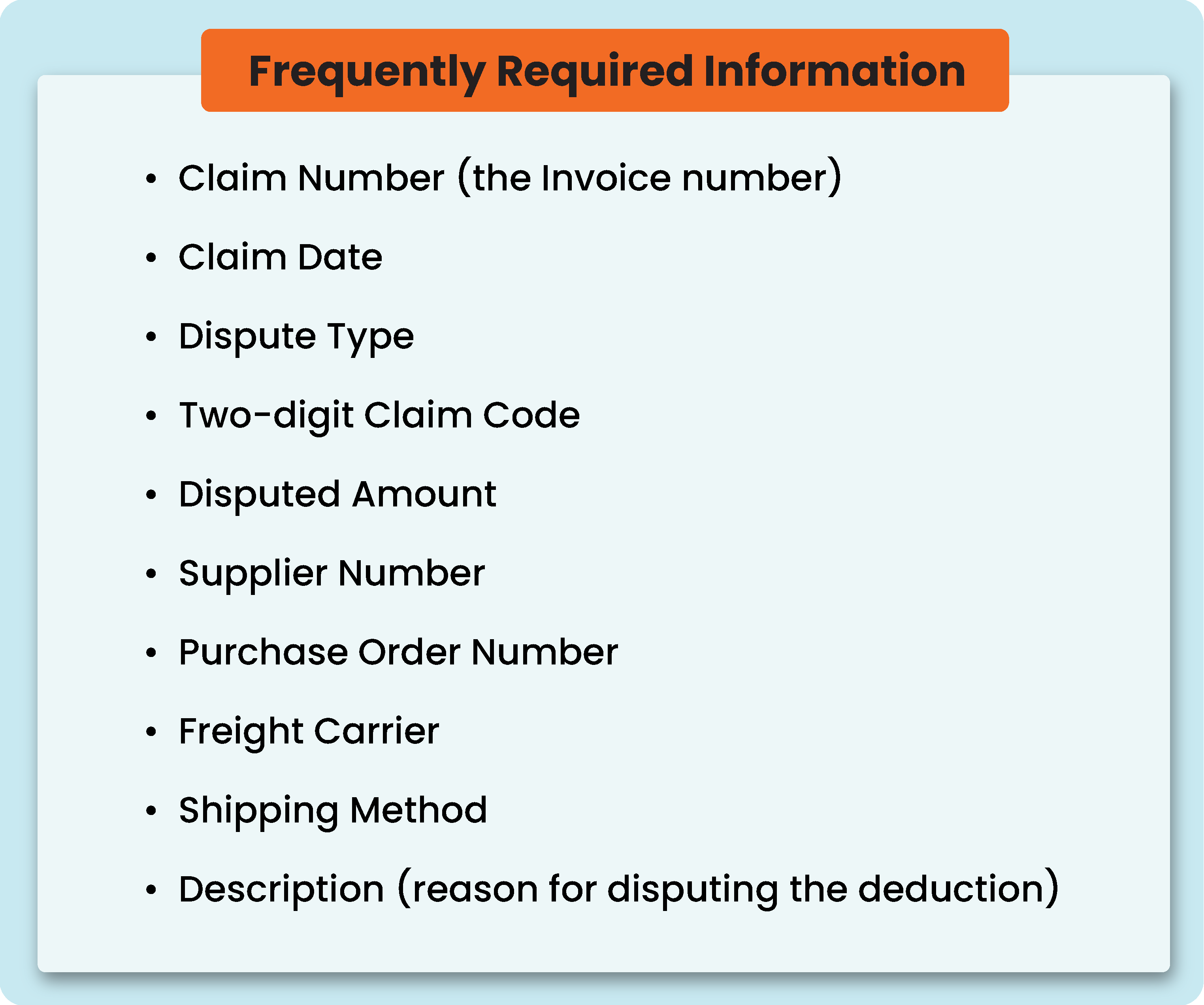
Documents Required by Deduction Type
- Shortage disputes: signed POD, pallet counts, carrier signature
- Pricing disputes: original PO, OSA, or supplier agreement, cost change effective date documentation
- Allowance disputes: allowance agreement, EDI acknowledgments proving cost change timing
- OTIF disputes: carrier appointment confirmations, TSCP 2.0 routing records, arrival timestamps
- SQEP disputes (through EIPP): SQEP Dashboard export, 856 and 997 EDI documents, exemption documentation if applicable
Most of these documents live in different systems: PODs and BOLs in the WMS, EDI records with the EDI provider, invoices in the ERP, and agreements in shared drives or contract management. Assembling them manually per dispute is where most AR teams lose the most time.
Best Practices for Walmart Deduction Recovery
Recovering more Walmart revenue comes down to five disciplines.
Master Both APDP and EIPP Portals
Know which fines go through APDP and which go through EIPP. Filing a SQEP dispute in APDP or a Code 22 dispute in EIPP wastes the dispute window.
Learn the Full Walmart Deduction Code System
Familiarity with Code 10, Code 22, Code 25, Code 64, and Code 65 (and the SQEP fine categories) lets your team identify root causes quickly and build accurate disputes. Codes are not interchangeable, and treating them as such produces avoidable denials.
Document Every Shipment at Origin
Photograph pallets, save signed BOLs, retain carrier appointment confirmations. Without documentation captured at the time of shipment, most shortage and OTIF disputes fail regardless of merit.
Reconcile Deductions Close to the Transaction
Walmart's own guidance is direct: it is always easier to manage issues as close to the transaction as possible, before they reach the post-audit stage where documentation becomes harder to reconstruct. Set a weekly cadence for pulling new deductions rather than batching monthly.
Run Root Cause Analysis on Recurring Deduction Codes
Every deduction is a diagnostic signal. Repeated Code 22 shortages point to fulfillment gaps. Recurring SQEP ASN fines point to EDI process breaks. Fixing the source of the fine is the highest-leverage recovery activity.
Automate Walmart Deduction Recovery with iNymbus
iNymbus automates the full Walmart deduction recovery workflow. The platform pulls deduction data from APDP and SQEP fine data from EIPP. It matches each claim against POs, invoices, PODs, BOLs, and EDI records from your ERP and EDI systems.
Dollar amounts get verified against backup documentation to the exact cent. Disputes are filed through the correct portal inside the required window. Every dispute is validated against Walmart's rules before submission.
What you get:
- Walmart deductions are disputed up to 30 times faster than manual processes
- 80 to 90 percent reduction in cost per claim
- Automatic reconciliation of dispute amounts against backup (no penny-off denials)
- Auto-fetching of 856 ASNs, 997 acknowledgments, EDI 850 POs, BOLs, and PODs
- Coverage of APDP standard deductions and EIPP SQEP disputes in one workflow
- Root cause analytics that show which codes, DCs, and SKUs drive the most deductions
- Coverage extends to 51+ retailers and carriers, including Amazon, Target, Kroger, Costco, Kohl's, CVS, Walgreens, Home Depot, UPS, and FedEx
If Walmart deductions are eating your margins and your AR team is disputing claims one at a time, iNymbus recovers what your business is owed and stops the recurring deductions at the operational root.
Schedule a free demo with the iNymbus team