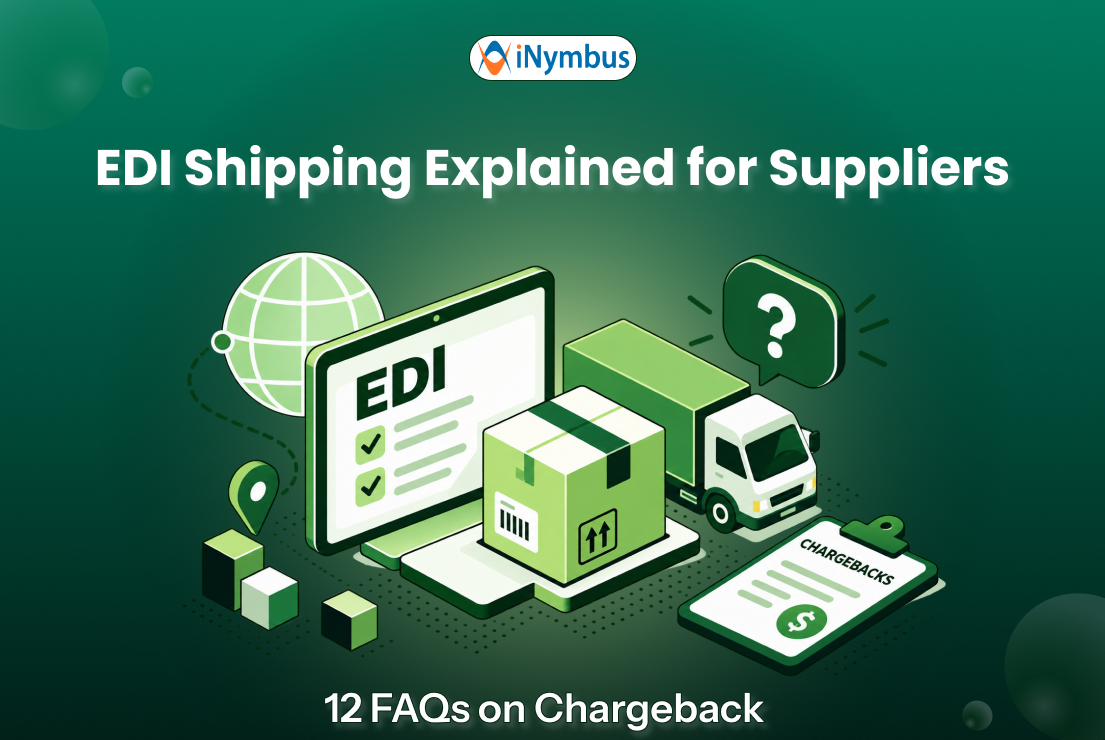
Electronic Data Interchange (EDI) is how suppliers and retailers exchange shipping information. Before a shipment reaches the distribution center, the retailer’s systems have already received an advance ship notice and set expectations for what is on the truck. If the file does not match the freight, the result is often a compliance deduction.
For suppliers shipping to retailers such as Amazon, Walmart, and Target, understanding EDI shipping is essential to avoid chargebacks and recover revenue when errors happen. This guide answers 12 common questions about EDI shipping, from what an EDI 856 is to which documents win a dispute.
What Is EDI Shipping?
EDI shipping is the electronic exchange of standardized shipping documents, such as the advance ship notice (EDI 856), between a supplier and a trading partner. It tells the retailer what is on a shipment before the truck arrives. When those files are wrong, retailers often respond with compliance deductions.
While EDI brings speed and accuracy to the order-to-cash cycle, it can also be complex to manage. Each retailer has its own requirements for formatting, labeling, and timing, so small errors add up quickly. Freight and ocean EDI are covered in question 12.
What Does the EDI Document Flow Look Like From Order to Payment?
Most retail relationships follow the same sequence of documents, and each transmission is normally confirmed with a 997 acknowledgment.
- 850 (Purchase Order): The retailer sends the order to the supplier.
- 856 (Advance Ship Notice): The supplier sends shipment details before the goods arrive.
- 810 (Invoice): The supplier bills the retailer after delivery.
- 820 (Remittance Advice): The retailer pays and lists any deductions and reason codes.
Amazon adds routing steps for some freight, where the supplier requests routing with a 753 and Amazon replies with a 754. The deduction appears at the end of the chain, but the cause often sits at the 856.
What Is an EDI 856, and Who Sends It?
An EDI 856 is the X12 transaction set for the ASN, also called the ship notice/manifest. The supplier sends it to the retailer before a shipment arrives, describing exactly what is inside. It typically includes:
- Order Details: Purchase order numbers, items, and quantities.
- Packaging Hierarchy: Pallets, cartons, and items, often in a strict structure. Amazon’s, for example, runs from shipment to order to pallet to carton to item.
- Barcoded Labels: Shipping label identifiers such as SSCC or UCC-128.
Receiving teams scan labels and match them against the ASN, so the 856 effectively becomes the retailer’s receiving record. It is usually generated by the supplier’s ERP or WMS, often through an EDI provider.
What Is the Difference Between an ASN and a Packing List?
The two documents serve different purposes, and the ASN carries more weight at the dock.
- Packing List: A paper or PDF document that travels with the goods and lists what the supplier says is inside.
- ASN: An electronic message sent ahead of the shipment in a structured format that the retailer’s systems read automatically.
The two should agree, and the ASN is normally matched against a previously provided packing list. Receiving teams rarely have time to break down cartons, so they rely on scanning barcodes linked to the ASN. If the ASN is wrong, a perfect packing list rarely saves you at the dock.
What Does a 997 Actually Prove?
A 997 is a functional acknowledgment that the receiving system sends back after it receives an EDI file. Here is what it does and does not tell you:
- What It Confirms: The file was received and passed basic syntax checks, meaning the structure was readable.
- What It Does Not Confirm: That the retailer agreed with the content, accepted the shipment, or judged the ASN accurate.
In disputes, a 997 is useful evidence that you transmitted the 856 on a specific date and that the partner’s system received it. It will not prove the quantities were right. Some trading partners use a newer acknowledgment version such as the 999, so check your partner’s specification.
What Are the Most Common ASN Errors?
Industry guidance on Amazon ASN chargebacks points to a few recurring problems:
- Carton Content Mismatch: Carton contents or unit counts that do not match what was received.
- Late or Missing ASNs: ASNs sent after the shipment arrives, or not sent at all.
- Invalid Routing References: Missing or invalid routing reference numbers.
- Expiration Date Issues: Missing or invalid expiration dates.
- Label Non-Compliance: Walmart’s programs add ASN accuracy and shipping label requirements, with UCC-128 as the labeling standard.
Behind most of these is a data mismatch between what was picked and packed and what the ERP or WMS declared. Manual keying, pack changes made after the ASN was generated, and amended purchase orders are common causes.
Why Do Retailers Charge for ASN Errors?
Retailers run receiving on the assumption that the ASN is accurate. An accurate one lets a distribution center check in freight quickly, put product away, and pay the right invoice. An inaccurate one creates shortages, overages, and manual rework, and retailers pass those costs back to suppliers through penalties.
Enforcement is usually automatic. Amazon applies ASN accuracy chargebacks and investigates disputes after the deduction is taken. Walmart separates delivery performance (OTIF) from quality programs that cover PO accuracy, labeling, and ASN quality. For suppliers, a data error ends up as a short pay on a remittance.
How Long Do I Have to Dispute a Shipping Deduction?
The window depends on the retailer, and the clock usually starts when the deduction is issued, not when you notice it. Industry sources commonly describe windows between 30 and 90 days.
- Amazon Vendor Central: 30 days from notification for ASN chargebacks, with a second dispute allowed within 30 days if the first is rejected. After that, the decision is final.
- Walmart and Others: Deadlines are set through retailer portals and vendor manuals, so check the current rules for each program.
Missing a window usually means the deduction stands, even if you were right. Treat every unreviewed deduction as time-sensitive.
Which Documents Win a Shortage Dispute?
The strongest dispute packages prove three things: what was ordered, what you declared, and what actually moved. For a shortage or ASN dispute, gather:
- Purchase Order: The final version, since amended POs often cause false shortages.
- EDI 856 and 997: The file or transmission log showing what was sent, when it was sent, and that it was received.
- Shipping Documents: The bill of lading and the carrier’s proof of delivery with a timestamp.
- Invoice: The matching supplier invoice.
- Photos (Carton Content Disputes): Images of opened cartons with visible barcodes, which Amazon’s process asks for.
Contradictions on the retailer’s side, such as a receiving record that conflicts with its own scorecard, can be decisive. Collect everything from your ERP, EDI, portals, and email before the window closes.
Want to learn how to dispute retailer deduction codes effectively? Check out our detailed blog post.
EDI or API: Which Is Better for Suppliers?
For retail suppliers, this is rarely an either-or choice. Retailers require EDI for core transactions, so EDI stays. APIs fill the gaps where real-time data matters.
- EDI: The standardized backbone for purchase orders, ASNs, and invoices.
- APIs: Used for interactive steps like rate shopping, booking, and shipment tracking.
Industry analysis describes most logistics operations as hybrid, with APIs layered on top of EDI for visibility. API vendors project faster growth for APIs, yet one vendor estimate still has most of the global supply chain running on EDI. For suppliers, the real question is not replacing EDI but deciding which events need real-time data. The table below compares the options.
Who Owns EDI Shipping: The EDI Team or AR?
Responsibility is shared, which is why errors often linger. Here is how it usually splits:
- EDI or IT Team: Owns transmission, mapping, and trading partner specifications.
- Warehouse and Logistics: Own the accuracy of what is packed, labeled, and declared.
- AR or Deductions Team: Owns the dispute and the recovery.
When these groups work separately, the deduction reaches AR weeks after the cause, with no link back to the process that created it. A workable model is to name one owner for deduction root causes, review reason codes by retailer and SKU every month, and share the findings with EDI and shipping. Disputes recover money. Root-cause fixes stop the repeat.
Is EDI Shipping the Same as Freight EDI?
Not quite, because the term is used loosely. The documents depend on the context:
- Retail Supplier Compliance: 850 purchase order, 856 ASN, and 810 invoice.
- Trucking and Freight: 204 load tender, 990 tender response, 214 shipment status, and 210 freight invoice.
- Ocean Shipping: Sets such as 300 and 301 for booking, connecting carriers, forwarders, and customs.
All three share the X12 framework (EDIFACT outside North America) but serve different parties. If a deduction traces to a carrier delivery problem, you may need both sides: the retailer-facing 856 and carrier-side proof such as the 214 or the proof of delivery.
EDI vs API vs Retailer Portal: Side-by-Side
|
EDI |
API |
Retailer portal |
|
|
What it is |
Standardized document exchange (X12, EDIFACT) |
Real-time request and response between systems |
Web interface run by the retailer, such as Vendor Central or Retail Link |
|
Best for |
Mandated, high-volume transactions: POs, ASNs, invoices |
Rates, booking, tracking, real-time visibility |
Manual uploads, scorecards, deduction details, disputes |
|
Who requires it |
Retailers, as a condition of doing business |
Usually optional, chosen for speed |
Retailers, for access to data and disputes |
|
Speed |
Batch or near real time |
Real time |
Manual, depends on the user |
|
Setup effort |
High: partner-specific mapping and testing |
Moderate: developer work and versioned endpoints |
Low to start, labor-intensive at scale |
|
Value in a dispute |
Strong: 856 files, transmission logs, 997s |
Useful: event timestamps and tracking data |
Essential: where disputes are filed, but evidence comes from elsewhere |
How iNymbus Simplifies EDI Shipping Deductions
While EDI gives suppliers a structured way to share shipping data, resolving the deductions that come from EDI errors is still manual, time-consuming work for many teams. That’s where iNymbus comes in. By leveraging automation and RPA (Robotic Process Automation) technology, iNymbus streamlines the deduction dispute process from detection to recovery.
How iNymbus Supports Your EDI Shipping Workflow:
- Auto-Detect New Deductions: Automatically monitors retailer portals for new deductions as they appear.
- Fetch Supporting Documents: Gathers EDI 856 and 997 records, bills of lading, proofs of delivery, and invoices from your ERP, EDI, portals, and email.
- File Disputes Automatically: Completes descriptions, fills out forms, and submits disputes within retailer deadlines.
- Identify Root Causes: Shows which retailers, SKUs, and reason codes drive the most deductions, so EDI and shipping teams can fix issues upstream.
With iNymbus, suppliers can shift from hours of manual work to an automated workflow, saving time, reducing errors, and accelerating recovery.
If deduction management is eating into your team’s productivity, consider scheduling a quick discovery call to see how iNymbus automation can transform your deduction recovery process.