Your invoice says $10,000. Your remittance says $0.00; no check arrived, no email explained it, and the invoice still shows as paid.
That usually isn’t an error. It’s three things happening at once: the retailer took deductions, collected them through settlement netting, and the result on your side was a short pay. The terms get used interchangeably, but they describe different layers of the same payment, and confusing them is how suppliers lose track of money they could recover.
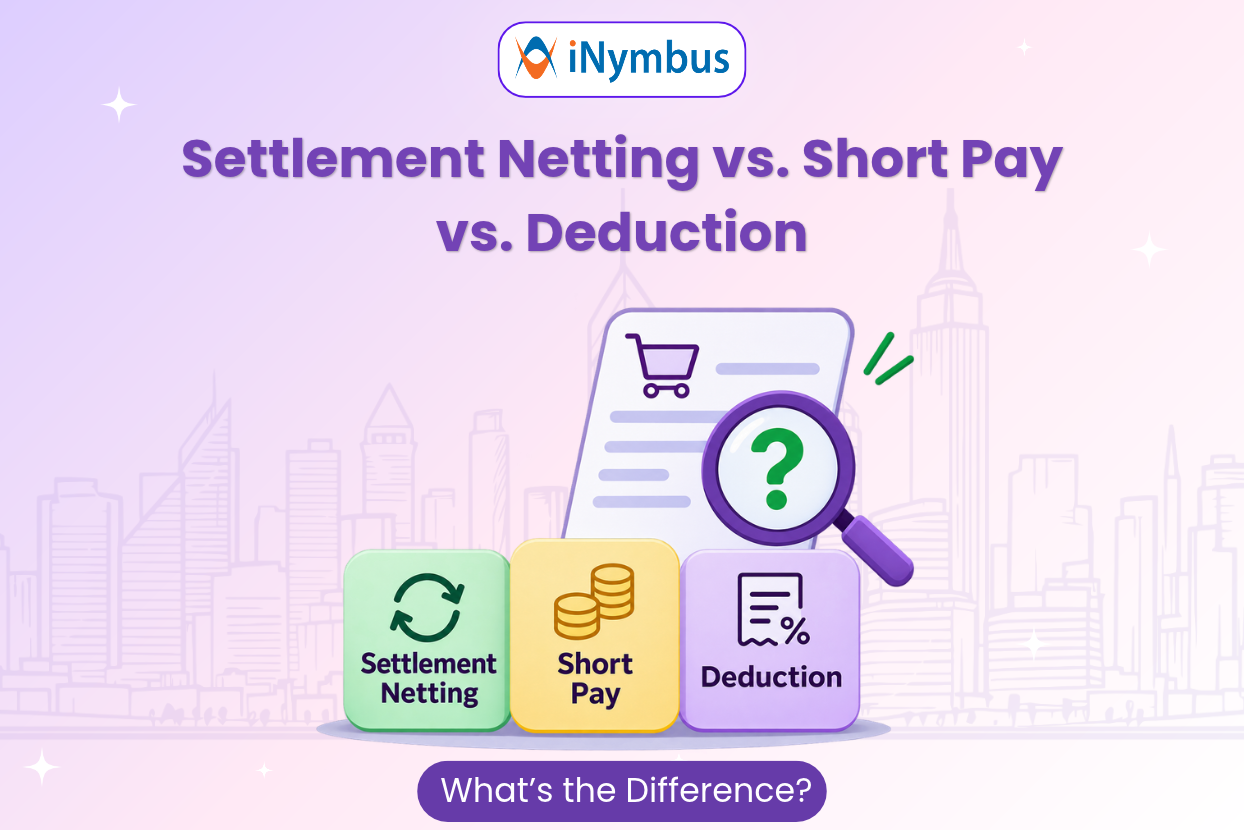
Deduction, Settlement Netting, and Short Pay in One Line Each
A deduction is the reason money was taken, settlement netting is the method used to collect it, and a short pay is the result in your bank account.
|
Term |
Layer |
One-Line Definition |
|
Deduction |
The reason |
A debit or credit memo that takes money for a shortage, promotion, fee, or other charge |
|
Settlement netting |
The method |
The retailer offsets what you owe against what it owes you, so only the difference moves |
|
Short pay |
The result |
You received less than the invoice amount |
A deduction explains why money was taken. Netting is one way the retailer collects it. A short pay is what shows up in your bank account. A single payment can involve all three.
What Is a Deduction?
A deduction is a charge a retailer takes against what it owes a supplier. At Target, it takes the form of a credit memo that deducts money from the vendor’s account, issued for shortages, cost differences, advertising claims, or vendor compliance.
Most deductions fall into a few families: receiving discrepancies, pricing differences, promotional and co-op agreements, returns, compliance fees, and post-audit findings. Most Kroger deductions are contractual, coming from promotional, coupon, or sales-based agreements, or from logistics compliance fee schedules.
Claims, Deductions, and Chargebacks at Walmart
Walmart splits what other retailers call deductions into three categories:
|
Walmart Term |
What Triggers It |
Examples |
|
Claims |
A mismatch between the PO, receiving, and invoice |
Price differences, shortages, allowances missing from the invoice |
|
Deductions |
Pre-negotiated agreements |
Returns, excess defectives, co-op, post-payment audit programs, allowances |
|
Chargebacks |
Failure to meet supply chain standards |
OTIF and SQEP fines |
Deduction vs. Chargeback: Terminology Varies by Retailer
Walmart distinguishes accounts payable deductions from accounts receivable chargebacks, while Target and most other retailers use the two words interchangeably. On a remittance, the retailer’s own category and code tell you more than the label.
What Is a Short Pay?
A short pay is a payment smaller than the invoice total. It’s an outcome, not a document: no retailer issues a “short pay,” and it only appears when you compare the amount paid with the amount invoiced.
Common Causes of Short Pays
- Shortage deductions: the retailer recorded fewer units received than invoiced
- Cost differences: the invoiced price did not match the retailer’s cost
- Split shipments: part of the order had not been received when the invoice was paid
- Compliance fines: fees for late delivery, labeling, or documentation errors
- Allowances: promotional or co-op amounts taken from the payment
- Debit balances or holds: prior amounts owed applied against the current payment
At Home Depot, an invoice that falls outside match tolerance results in a chargeback and a short payment for the quantity or cost difference. At Kohl’s, a split shipment gets full payment of the original invoice plus a shortage deduction for units not yet received.
A shortage is one cause of a short pay, not another name for it. A short pay caused by a promotional allowance has nothing to do with shortages.
What Is Settlement Netting?
Settlement netting, also called payment netting, offsets what a supplier owes a retailer against what the retailer owes the supplier, so only the net difference is paid. It typically requires a netting agreement between the two parties.
Netting doesn’t create new charges. It changes how existing deductions are collected: instead of billing you or sending a separate memo, the retailer subtracts deductions from your payables before any money moves.
How Kroger Settlement Netting Works
Kroger changed its netting process in October 2025, and two changes affect every supplier:
- Single remit-to: Kroger uses one remit-to across all divisions, which reduces the number of remittance references suppliers receive
- No more $1.00 checks: netting goes to $0.00 instead of producing a $1.00 check, and payments are applied from remittance data in Supplier Connect
Kroger nets promotional, coupon, logistics compliance, and payment correction deductions against what it owes for goods and services. Remittances show five method types:
|
Remittance Method Type |
What It Means |
|
ORA_AP/AR Netting |
A Kroger deduction or memo |
|
Netting |
A payment against a supplier invoice made through netting, with no separate check; amounts apply to any open balance on that invoice |
|
EFT |
Payment released by electronic funds transfer |
|
Check |
Paper payment sent to the supplier’s address |
|
Refund |
A refund or correction on a Kroger-generated deduction |
Is a $0.00 Payment a Missed Payment?
A $0.00 Kroger payment usually means your deductions equaled or exceeded what Kroger owed you for that settlement, not that a payment was missed. Kroger treats netting as a form of payment: what you owe is deducted instead of paid through a separate remittance.
Kroger doesn’t email or mail notice of netting. Without a regular export of Supplier Connect remittance data, netted payments go unnoticed.
Settlement Netting vs. Short Pay vs. Deduction: Side-by-Side
|
Deduction |
Settlement Netting |
Short Pay |
|
|
What it is |
The reason and its document |
The collection method |
The outcome |
|
Who starts it |
The retailer, from a mismatch, contract, or fee |
The retailer’s AP and AR process |
Result of the first two |
|
What you see |
A deduction line or memo on the remittance |
Netting lines, possibly a $0.00 payment |
A paid amount below the invoice amount |
|
Can you dispute it? |
Yes, with documentation inside the deadline |
Not the netting itself; dispute the deductions inside it |
Dispute the underlying deductions |
|
Can it happen with no cash moving? |
No |
Yes |
Only when fully offset |
Worked Example: One $10,000 Invoice, Three Outcomes
Illustrative numbers. A supplier invoices a retailer $10,000. The retailer posts three deductions: a $300 shortage, a $200 cost difference, and a $1,000 promotional allowance, totaling $1,500.
|
Scenario |
What the Supplier Owes |
Net Payment |
What the Remittance Shows |
|
Short pay only |
$1,500 in deductions on this invoice |
$8,500 |
One payment with three deduction lines |
|
Netting, supplier owes less |
$2,000 in total deductions across the account |
$8,000 |
Netting lines, payment of the difference |
|
Netting, supplier owes more |
$12,000 in total deductions across the account |
$0.00 |
Netting lines, $2,000 balance still owed |
The third scenario creates the most confusion. The invoice is paid in full through netting, no cash arrives, and the supplier still owes $2,000. Without exporting remittance detail, it looks like a missing payment rather than a fully applied one.
Kroger follows the same two patterns: when supplier deductions exceed Kroger’s payables, the payment nets to zero and a balance remains; when Kroger owes more, only the difference is paid.
In every scenario, the money is recovered the same way: by disputing the deductions inside the payment, not the netting or the short pay itself.
How Other Retailers Offset Deductions Against Payments
Kroger has formalized netting the most, but other retailers offset deductions against payments under different names.
|
Retailer |
How Offsets Work |
Where to Look |
|
Kroger |
Settlement netting nets deductions against payables, down to $0.00 |
Supplier Connect Payments View |
|
Target |
May deduct against goods on order, outstanding invoices, or the vendor account; debit balances and holds can stop invoice payment |
Partners Online; Target.Collections@target.com for holds and debit balances |
|
Home Depot |
Remittances combine invoice payments, RTVs, co-op, rebates, and compliance fines; compliance offsets post on the next payment after the dispute period closes |
EDI 820 remittance advice |
|
Walmart |
AP claims and deductions are taken from payments; AR chargebacks use separate codes and a separate portal |
APIS, Supplier One Payments, High Radius |
|
Kohl’s |
Cash discounts delayed by a debit balance or hold are deemed earned; shortages and cost differences appear in remittance detail |
EDI 820 remittance advice |
Repeated short pays on the same Home Depot items usually point to SKU data problems rather than shipping errors.
Why Netting Can Shorten Your Dispute Window
At Kroger, the 180-day dispute window for vendor non-compliance fees starts on the original deduction date, which appears in Supplier Connect as the netting remittance reference date. Because Kroger doesn’t send netting notices, a supplier who exports remittance data monthly may find a netted deduction weeks after its clock started.
|
Export Frequency |
Days Lost Before Review (Worst Case) |
Dispute Days Remaining |
|
Daily |
1 |
179 |
|
Weekly |
7 |
173 |
|
Monthly |
30 |
150 |
|
Quarterly |
90 |
90 |
Kroger deducts fees from outstanding invoices, and amounts not deducted within 60 days must be paid by check. Netting is the default collection path, so the deductions inside it are the ones to monitor.
How to Reconcile Short Pays and Netted Payments
- Export remittance data on a schedule: in Kroger’s Supplier Connect, open Transactions, switch to the Payments view, and export by payment reference date, settlement number, or invoice number. Weekly is the practical minimum
- Match payments to invoices: compare each invoice amount with the amount paid or netted to find every short pay
- Break out the deductions: list every deduction inside the settlement by code, reason, and amount
- Separate valid from invalid: check each deduction against your POs, BOLs, PODs, agreements, and pricing
- Track open balances: when netting leaves a balance owed, record it so it is not mistaken for a missing payment later
- Dispute inside the window: file the invalid deductions through the retailer’s channel, with documentation, before the deadline
- Watch for patterns: recurring short pays on the same SKU or code usually trace to item data, pricing, or shipping problems you can fix upstream
Reconcile Netted Payments and Recover Invalid Deductions With iNymbus
Settlement netting saves retailers time, but it moves the work to suppliers: exporting remittances, unpacking netted settlements, matching deductions to invoices, and disputing the invalid ones before the clock runs out.
iNymbus automates that work. It pulls remittance and deduction data from retailer portals including Kroger Supplier Connect, matches every deduction to its invoice and supporting documents, and files disputes for invalid charges before the deadline, across 52+ retailers.
See how iNymbus turns netted settlements into disputable deduction lines.