



Every year, retail suppliers and CPG brands lose a portion of their earned revenue without ever realizing it. This isn't fraud or theft in the traditional sense. It's revenue leakage, and it happens quietly, invoice by invoice, deduction by deduction, until the losses become significant enough to affect margins and cash flow.
Most articles on this topic focus on subscription billing, SaaS pricing, or telecom services. Those examples don't reflect what actually causes revenue leakage for suppliers who sell into major retailers.
This guide explains what revenue leakage is, why it happens, and how it specifically shows up in retail supplier operations through deductions, chargebacks, pricing discrepancies, and freight claims.
What Is Revenue Leakage?
Revenue leakage is income a business earns but fails to collect due to operational errors, billing mistakes, pricing inaccuracies, unresolved disputes, or process inefficiencies. It's the gap between what a company should be paid and what it actually receives.
Unlike revenue loss, which usually comes from a single identifiable event like a lost customer or a canceled contract, revenue leakage is gradual and often invisible.
It builds up across thousands of small transactions, and because each instance seems minor, it rarely gets the attention it deserves until finance teams add up the total impact.
For retail suppliers, revenue leakage often looks like this: a retailer takes a deduction from a payment for a compliance issue, an invoice gets shortpaid because of a pricing mismatch, or a freight claim is never filed before the carrier's deadline.
None of these events show up as a dramatic loss. They show up as a slightly smaller payment than expected, and that pattern repeats across hundreds or thousands of invoices every month.
Why Revenue Leakage Happens
Revenue leakage typically stems from gaps between systems, processes, and the people managing them. A few root causes drive most of it:
Manual processes: When deductions, claims, and disputes are handled manually, human error becomes inevitable. Someone misses a deadline, misreads a code, or simply runs out of time to investigate every discrepancy.
Disconnected systems: Retailers, suppliers, carriers, and banks all use different portals and platforms. Data doesn't always match across these systems, and reconciling it takes time that most finance teams don't have.
High transaction volume: Suppliers working with large retailers process an enormous number of invoices, purchase orders, and deductions. Even a small error rate translates into meaningful dollar losses at scale.
Lack of visibility: Without a centralized way to track deductions and disputes, finance teams often don't know how much revenue is actually at risk until it's too late to recover it.
Deadline pressure: Retailers and carriers impose strict deadlines for disputing deductions or filing claims. Miss the window, and the revenue is gone permanently, regardless of whether the original deduction was valid.
10 Common Causes of Revenue Leakage
-
Billing errors, such as incorrect invoice amounts or duplicate charges
-
Pricing discrepancies between contracted rates and what's actually invoiced
-
Unauthorized or invalid deductions taken by retailers
-
Missed freight claim deadlines with carriers
-
Unprocessed credits or returns that were never applied
-
Promotional or trade compliance penalties applied without verification
-
Short payments that go uninvestigated because the amounts seem small
-
Manual data entry mistakes during invoice reconciliation
-
Contract terms that aren't properly reflected in billing systems
-
Chargebacks that are accepted without review because disputing them takes too much staff time
Revenue Leakage Examples in Retail and CPG
Generic examples don't capture what suppliers actually deal with. Here's what revenue leakage looks like in real retail supplier operations:
ASN compliance deductions: A major retailer deducts payment because an Advance Ship Notice was submitted late or contained an error, even though the shipment itself arrived on time and complete.
Pricing mismatches: A retailer's system reflects an old contract price, so every invoice for that product gets underpaid until someone catches the discrepancy, sometimes months later.
Missed freight claims: A shipment arrives damaged or short, but the claim isn't filed before the carrier's cutoff, so the supplier absorbs the cost instead of recovering it.
Unvalidated promotional deductions: A retailer takes a deduction for a promotional allowance that was never actually agreed to, and the deduction is accepted by accounts receivable simply because nobody has time to challenge it.
Aging chargebacks: A batch of chargebacks sits unresolved for months because reviewing and disputing each one manually requires pulling proof of delivery, matching purchase orders, and submitting documentation through a retailer's dispute portal, a process that can take hours per claim.
Each of these examples represents real, recoverable money. The problem is rarely a single large loss. It's the accumulation of small ones across an entire customer base of retailers.
How to Identify Revenue Leakage
Finding revenue leakage requires looking at the full picture of deductions, disputes, and payment discrepancies rather than reviewing transactions in isolation. A few practical steps help:
Audit deduction codes regularly: Categorize deductions by type and retailer to spot patterns. If one retailer consistently takes deductions for the same reason, that's a signal worth investigating.
Track claim win rates: Measure how many disputes and claims are actually filed versus how many are won. A low filing rate often means revenue is being written off simply because nobody had the capacity to dispute it.
Reconcile pricing against contracts: Cross-check invoiced amounts against actual contract terms on a regular basis, not just when a discrepancy is reported.
Measure aging on unresolved disputes: Deductions and claims that sit unresolved past their dispute window represent revenue that's effectively gone. Tracking aging helps identify where processes are falling behind.
Calculate deduction-to-revenue ratio: Comparing total deductions against total revenue over time reveals whether leakage is growing, shrinking, or staying flat.
How to Prevent Revenue Leakage
Prevention starts with tightening the processes that create the most exposure:
-
Standardize invoicing and ensure pricing data stays synced with current contracts
-
Set internal deadlines ahead of retailer and carrier cutoffs, not right at them
-
Require documentation for every deduction before it's accepted as valid
-
Build a consistent review process for chargebacks instead of handling them case by case
-
Centralize deduction and claims data so finance teams have visibility across all retail partners
How to Fix Revenue Leakage
Once leakage is identified, fixing it comes down to recovery and correction. That means disputing invalid deductions with proper documentation, filing freight claims promptly and following up until they're resolved, correcting pricing errors at the source so they don't recur, and reconciling short payments rather than writing them off.
The challenge for most finance teams isn't knowing what to do. It's having the staff time to do it consistently across every retailer, every deduction, and every claim. This is where automation becomes less of a nice-to-have and more of a necessity.
Revenue Leakage vs Revenue Loss
The two terms get used interchangeably, but they describe different problems. Revenue loss usually refers to a clear, identifiable event, like losing a customer, a canceled order, or a product recall. It's visible and easy to quantify.
Revenue leakage is different. It's the slow erosion of income through small, often unnoticed errors and inefficiencies. It doesn't show up on a single line item. It shows up as a gap between expected revenue and collected revenue that only becomes visible when you add everything up.
The Hidden Cost of Revenue Leakage
Revenue leakage rarely gets the attention it deserves because each instance looks small. A single deduction, a single short payment, a single missed claim, none of these seem worth escalating. But across a supplier's entire retail customer base, the cumulative effect can represent a meaningful percentage of annual revenue.
Beyond the direct dollar impact, revenue leakage also consumes staff time. Every hour spent manually investigating a deduction or filing a claim is an hour not spent on higher-value work. That indirect cost often exceeds the direct financial loss.
How Automation Helps Stop Revenue Leakage
Manual processes simply can't keep pace with the volume and complexity of modern retail deductions and claims. Automation changes that by handling repetitive, rules-based tasks like pulling proof of delivery, matching purchase orders, submitting disputes through retailer portals, and filing freight claims, all without requiring a person to do it manually for every single transaction.
Automation doesn't just save time. It closes the gap between when a deduction happens and when it gets disputed, which directly improves recovery rates. It also creates consistency, since automated processes don't skip claims because someone is busy or a deadline slips through the cracks.
How iNymbus Helps Retail Suppliers Recover Lost Revenue
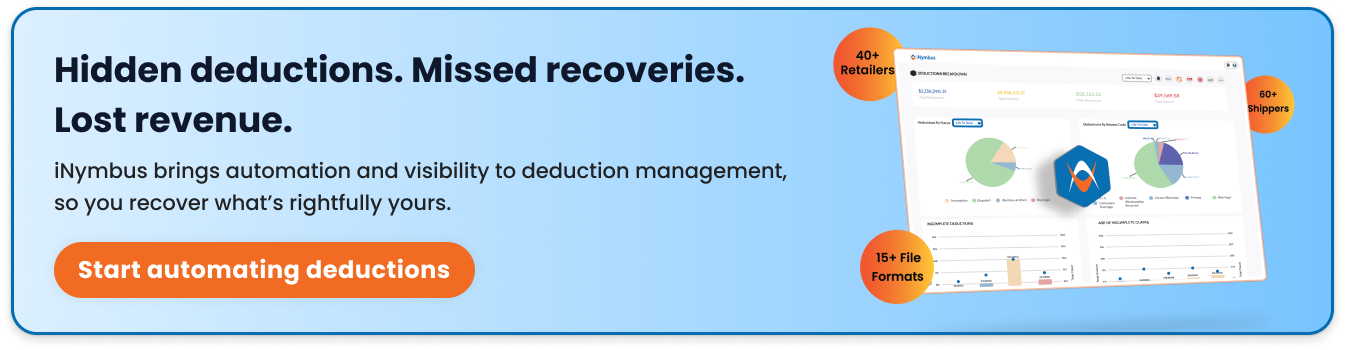
This is exactly the problem iNymbus was built to solve. While most revenue leakage solutions are designed for generic billing or subscription use cases, iNymbus focuses specifically on the deduction, chargeback, and freight claim challenges that retail suppliers and CPG brands deal with every day.
iNymbus uses cloud-based automation to handle deduction disputes and freight claims at scale, without requiring suppliers to hire more staff or expand their finance teams.
Instead of manually pulling documentation, matching invoices to purchase orders, and submitting disputes through retailer portals one at a time, iNymbus automates the entire workflow, from claim submission to resolution tracking.
For a supplier managing deductions across multiple major retailers, this means:
-
Automated dispute filing that keeps pace with high transaction volumes
-
Faster claim submission that beats retailer and carrier deadlines consistently
-
Centralized visibility into deduction trends, win rates, and aging disputes
-
Recovery of revenue that would otherwise be written off simply due to lack of staff time
The result isn't just recovered revenue. It's a finance team that spends less time on manual dispute work and more time on strategic priorities. If your team is losing revenue to deductions, chargebacks, or unfiled freight claims, that's not a staffing problem. It's a process problem, and it's one iNymbus was built to solve.
Frequently Asked Questions
Still Chasing Deductions Manually?
Recover lost revenue with iNymbus automation


.webp)