
A supplier can have the best products, competitive pricing, and reliable inventory, yet still lose thousands of dollars every year because of EDI errors. A late ASN, an incorrect invoice, or a failed purchase order transmission can trigger chargebacks, delay payments, and damage retailer scorecards.
That's why choosing an EDI provider isn't just an IT decision. It's a business decision that affects operations, finance, and customer relationships.
This guide explains what to look for when evaluating an EDI provider, helping you make a confident decision that supports both your current operations and future growth.
What Is an EDI Provider?
An EDI provider is a company that enables businesses to exchange standardized business documents electronically with customers, suppliers, logistics partners, and retailers.
Instead of manually emailing or entering documents into multiple systems, EDI automates the entire process using standardized formats such as ANSI X12 and EDIFACT.
Common EDI documents include:
-
Purchase Orders (EDI 850)
-
Purchase Order Acknowledgments (EDI 855)
-
Invoices (EDI 810)
-
Inventory Reports
-
Shipment Status Updates
-
Payment Remittance Advice (EDI 820)
A modern EDI provider also helps businesses connect with multiple trading partners, validate document accuracy, translate data between systems, monitor transactions in real time, resolve transmission errors, and maintain retailer compliance.
For suppliers working with large retailers, these capabilities are essential for maintaining strong supplier performance and avoiding costly deductions.
Why Choosing the Right EDI Provider Matters
Many organizations treat EDI as a technical requirement. In reality, it has a direct impact on operations, finance, customer satisfaction, and revenue.
A reliable EDI provider helps you improve retail compliance. Large retailers have strict EDI requirements. Missing or incorrect documents can trigger compliance violations, delayed payments, and chargebacks. An experienced provider reduces these risks by validating transactions before they're transmitted.
It also reduces manual work. Instead of manually processing orders, invoices, and shipment notices, automation allows your team to focus on higher-value activities. This improves productivity while reducing human error.
Scalability matters too. As your customer base grows, the number of trading partners and EDI transactions increases significantly. A scalable EDI platform allows you to onboard new retailers without rebuilding your entire integration process.
Modern EDI providers offer dashboards and real-time monitoring that allow teams to quickly identify failed transactions, shipment delays, and integration issues before they become larger problems.
Your EDI solution should grow alongside your business. Whether you're adding new warehouses, expanding internationally, or integrating new ERP systems, your provider should support long-term scalability rather than requiring a costly migration later.
8 Factors to Consider When Choosing an EDI Provider
Every EDI provider claims to offer reliable integrations and excellent support. The real difference lies in how well they support your business goals, retailer requirements, and operational processes.
Rather than comparing feature lists, evaluate providers based on how they perform in real business scenarios.
1. Ask Them to Demonstrate Experience With Your Retailers
Not every EDI provider specializes in retail. Some focus on healthcare, manufacturing, or transportation. While they may offer strong technical capabilities, they may lack experience with retailer-specific requirements.
Look for providers that have experience working with Walmart, Target, Amazon Vendor Central, Costco, Kroger, Home Depot, Lowe's, and other major retailers relevant to your business.
An experienced retail EDI provider understands retailer compliance requirements, document specifications, testing procedures, and common issues that suppliers face. This expertise can significantly reduce implementation time and help prevent compliance-related chargebacks.
Questions to ask: Which retailers do you currently support? How many retail suppliers use your platform?
2. Verify How the Platform Integrates With Your Existing Systems
Your EDI solution should work with your existing technology instead of forcing your team to change established workflows.
Look for seamless integration with ERP systems, Warehouse Management Systems (WMS), Transportation Management Systems (TMS), accounting software, Order Management Systems, and inventory management platforms.
The goal is to eliminate duplicate data entry while maintaining accurate information across all business systems. A well-integrated EDI platform automatically synchronizes orders, inventory, shipping information, invoices, and payment data. This minimizes errors while providing greater operational efficiency.
Ask your provider: Which ERP systems do you support? Do you offer API integrations? How long does implementation usually take? Do you provide custom integrations if required?
3. Evaluate Whether the Platform Can Scale With Your Business
Your current transaction volume should not be the only factor when selecting an EDI provider. Think about where your business will be in three to five years.
Consider whether the provider can support more trading partners, higher document volumes, additional warehouses, international operations, new retail channels, omnichannel fulfillment, and marketplace integrations.
Migrating to a new EDI provider later can be expensive and disruptive. Choosing a scalable solution today helps avoid unnecessary implementation costs in the future. Look for cloud-based platforms that allow your business to grow without major infrastructure investments.
4. Review Security Beyond Compliance Certifications
EDI documents contain sensitive business information, including pricing, customer details, purchase orders, invoices, and payment information. Security should never be an afterthought.
Ask potential providers about data encryption, secure communication protocols, access controls, disaster recovery, backup procedures, audit trails, and compliance certifications such as SOC 2 or ISO 27001.
Your provider should also have clear procedures for monitoring transactions, preventing unauthorized access, and responding to security incidents. Strong security protects both your organization and your retail partners.
5. Evaluate the Quality of Customer Support
Even the best EDI platforms occasionally experience errors, mapping changes, or retailer updates. When issues occur, fast support matters.
Evaluate implementation assistance, dedicated account managers, technical onboarding, response times, 24/7 support availability, retailer testing assistance, and ongoing optimization services.
A provider that simply offers software isn't enough. The best partners actively help your team resolve issues before they impact retailer relationships.
Ask questions like: Who manages onboarding? How quickly do you respond to critical issues? What is your average implementation timeline? Do you proactively monitor failed transactions?
Strong support can save hours of troubleshooting and prevent costly supply chain disruptions.
6. Understand the Real Cost of the Platform
Price is often one of the first things businesses compare when evaluating EDI providers. However, the lowest monthly subscription doesn't always translate into the lowest overall cost.
Many providers charge additional fees that only become apparent after implementation. These may include onboarding costs, document mapping fees, trading partner setup charges, support fees, software upgrades, API integrations, or transaction-based pricing.
Before signing a contract, ask for a complete breakdown of costs, including initial implementation fees, trading partner onboarding costs, document mapping charges, monthly platform fees, transaction limits, support or maintenance fees, custom integration costs, and additional user licenses.
A transparent pricing model makes budgeting easier and helps you avoid unexpected expenses as your business grows.
Instead of focusing only on cost, consider the total cost of ownership (TCO). A provider that charges slightly more but automates manual work, reduces retailer chargebacks, and minimizes implementation time often delivers a much better return on investment.
7. Look for Visibility, Not Just Document Exchange
EDI transactions don't stop after documents are exchanged. Your team needs visibility into every transaction to quickly identify and resolve issues.
A modern EDI platform should provide real-time reporting that answers questions such as: Which transactions failed today? Which retailer rejected a document? Are there any missing acknowledgments? Which orders are delayed? Are shipment notices being transmitted successfully?
Advanced reporting helps supply chain, operations, and finance teams identify problems before they affect customers or retailer scorecards.
Look for dashboards that include transaction status tracking, error notifications, performance reports, retailer compliance metrics, historical transaction logs, downloadable reports, and user activity tracking.
Better visibility means faster problem resolution and fewer costly disruptions.
8. Pre-Transmission Error Prevention
Most EDI providers offer error monitoring, but few draw the distinction that actually matters: are errors caught before a document reaches the retailer, or only reported after the retailer has already rejected it and applied a chargeback?
Post-transmission reporting tells you something went wrong. Pre-transmission validation stops the wrong document from ever leaving your system, catching mismatched PO numbers, incorrect quantities, missing required fields, or formatting errors before they become a deduction on your remittance.
This distinction is easy to miss in a sales demo because both look like real-time visibility on the surface. Ask specifically which one you are getting.
Questions to ask: Do you validate documents before or after transmission? Can you show me an example of an error your system caught before it reached a retailer?
10 Questions to Ask Before Choosing an EDI Provider
Once you've shortlisted a few providers, schedule a demo and ask detailed questions. Their answers will quickly reveal whether they're a long-term partner or simply another software vendor.
-
Which retailers and trading partners do you already support? Experience with major retailers can significantly reduce onboarding time and implementation risks.
-
How long does implementation typically take? Understand the expected timeline and what resources your team will need during implementation.
-
Which ERP and business systems integrate with your platform? A provider should support your current systems while remaining flexible enough to accommodate future changes.
-
What happens if an EDI transaction fails? Ask how errors are detected, who receives notifications, and how quickly issues are resolved.
-
What security certifications do you maintain? Look for providers that follow recognized security standards and protect sensitive business data.
-
Is your pricing fully transparent? Request a complete pricing breakdown, including future expansion costs.
-
How quickly can new trading partners be onboarded? Retailers regularly update requirements. Your provider should make onboarding simple rather than creating delays.
-
Do you provide a dedicated implementation or account manager? Having a single point of contact improves communication and speeds up issue resolution.
-
Can your platform scale as my business grows? Ask how the solution handles increasing document volumes, new warehouses, and international expansion.
-
Can you share customer success stories or references? A provider with satisfied long-term customers is usually a safer choice than one relying solely on marketing claims.
Red Flags to Watch Out For
While evaluating providers, keep an eye out for warning signs that may indicate future challenges.
-
Hidden Pricing: If pricing isn't clearly explained or additional fees appear throughout the sales process, proceed carefully.
-
Limited Retail Experience: General integration experience doesn't necessarily translate into expertise with retail EDI compliance.
-
Slow Customer Support: Delayed responses during the sales process often become even slower after implementation.
-
Limited Integration Options: If the platform cannot integrate with your ERP, WMS, or other critical systems, your team may end up relying on manual processes.
-
Poor Visibility: Without real-time reporting and transaction monitoring, identifying errors becomes difficult and time-consuming.
-
No Growth Strategy: Choose a provider that can support your business five years from now, not just today.
What to Confirm for Your Specific Retailers
|
Retailer |
What to confirm with your EDI provider |
|
Walmart |
Pre-built 850/855/856/810 maps, AS2 connectivity, OTIF-related ASN timing validation |
|
Amazon |
Carton-level ASN accuracy (SSCC-18), vendor central-specific formatting |
|
Target |
ROG-based invoice timing accuracy, EDI 864 error handling |
|
Costco |
PO-value-based deduction triggers, label/ASN sync validation |
EDI Provider Evaluation Checklist
Use this checklist when comparing multiple providers. The provider that checks the most boxes is generally the strongest long-term partner.
-
Supports all required retailers
-
Integrates with existing ERP/WMS
-
Supports ANSI X12 and EDIFACT
-
Transparent pricing model
-
Strong security and compliance certifications
-
Dedicated implementation support
-
Real-time reporting dashboard
-
Scalable cloud platform
-
Proven retail experience
-
Positive customer references
Why the Right EDI Partner Matters More Than Ever
Retail supply chains continue to become more complex. Retailers expect suppliers to exchange documents faster, maintain higher compliance scores, and respond quickly to operational changes.
An outdated or unreliable EDI solution can increase manual work, delay shipments, and contribute to costly deductions. Even with a solid EDI provider in place, many suppliers still find themselves drowning in retailer chargebacks and deduction disputes that EDI alone doesn't resolve.
The right EDI partner becomes an extension of your operations team by helping you improve document accuracy, reduce manual processing, accelerate retailer onboarding, increase supply chain visibility, and maintain retailer compliance. But document exchange is only part of the equation. Once those documents are in motion, deductions still happen and disputing them eats up hours your team doesn't have.
This is where suppliers often need more than EDI. Platforms like iNymbus pick up where EDI leaves off, automating the dispute process for retail deductions so your finance team isn't stuck manually fighting chargebacks.
It works alongside your existing EDI setup rather than replacing it, giving you visibility into deductions the same way your EDI platform gives you visibility into transactions.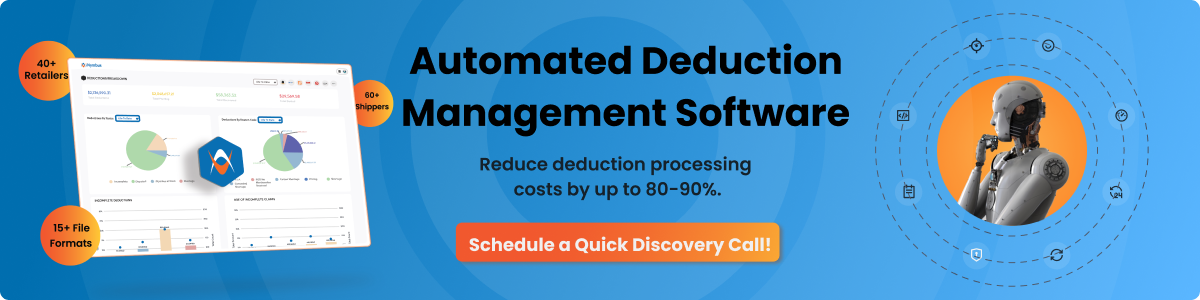
Final Thoughts
The right EDI provider is judged by what it prevents, not just what it processes. Ask where errors get caught, get accountability in writing, and match the provider to your actual retailers, not a generic capability list.
For suppliers who already have solid EDI in place and are still absorbing deductions and chargebacks, that's a separate, solvable problem, one worth addressing directly rather than hoping a better EDI setup alone will fix it.
Frequently Asked Questions
Still Chasing Deductions Manually?
Recover lost revenue with iNymbus automation